The Roman Amphitheater of Alexandria at Kom El Dekka is one of the most captivating archaeological treasures in Egypt, offering travelers a rare glimpse into the grandeur of Roman life in one of the world’s most historically rich cities. Known locally as the Roman amphitheater Alexandria, this ancient site sits in the heart of Alexandria Egypt, not far from the Corniche and the Mediterranean Sea. It’s more than just a collection of stone steps and columns—it’s a window into the cultural fusion between Egyptian, Greek, and Roman civilizations that once flourished here.
When visiting Alexandria, the ancient Roman theater Alexandria is a must-see landmark among the things to do in Alexandria Egypt. Built around the 2nd century AD, the Roman amphitheatre Alexandria Egypt at Kom El Dekka (meaning “Mound of Rubble”) wasn’t discovered until the 20th century. Today, it stands as the only known Roman amphitheater in Egypt, making it an unparalleled archaeological site that continues to fascinate travelers, historians, and photographers from all over the world.
Walking through its semi-circular design, you’ll notice the blend of Greek and Roman theatre elements—a design that allowed both acoustic perfection and social interaction. Visitors can still sit on the marble seats, which once hosted audiences for musical performances, poetry readings, and public events. Unlike the grand Colosseum of Rome, this amphitheater Alexandria was more intimate, reflecting Alexandria’s unique character as a cultural capital of the ancient Mediterranean.
For modern travelers planning to visit, Luxury Trips To Egypt, the best travel agency in Egypt, offers guided experiences that bring the Roman theater Alexandria to life. Their expert Egyptologists explain how this ancient Roman amphitheater Alexandria once echoed with the sounds of art, philosophy, and celebration—a setting that connects you deeply with the spirit of ancient Alexandria.
If you’re searching for places to visit in Alexandria, this site stands as a highlight among Alexandria tourist attractions, offering history lovers, photographers, and culture seekers an experience like no other. The Roman Amphitheater of Alexandria at Kom El Dekka represents the soul of a city that once rivaled Athens and Rome in knowledge and beauty.
History and Discovery of the Roman Amphitheater in Alexandria
The story of the Roman Amphitheater of Alexandria at Kom El Dekka begins not with its construction, but with its rediscovery. In 1960, during routine excavation work for a new government building, workers stumbled upon marble columns and curved stone structures. Egyptian archaeologists quickly realized they had uncovered something extraordinary—the remains of an ancient Roman amphitheater hidden beneath centuries of sand and modern development.
The discovery at Kom El Dekka completely transformed what scholars knew about Roman Alexandria. Until then, no one suspected that the city, known for its Greek and Roman theatre influences, held such a well-preserved amphitheater. Unlike the grand arenas built for gladiatorial games in Rome, this one served a more cultural purpose—it hosted concerts, lectures, and public meetings, making it a vital center of intellectual and artistic life.
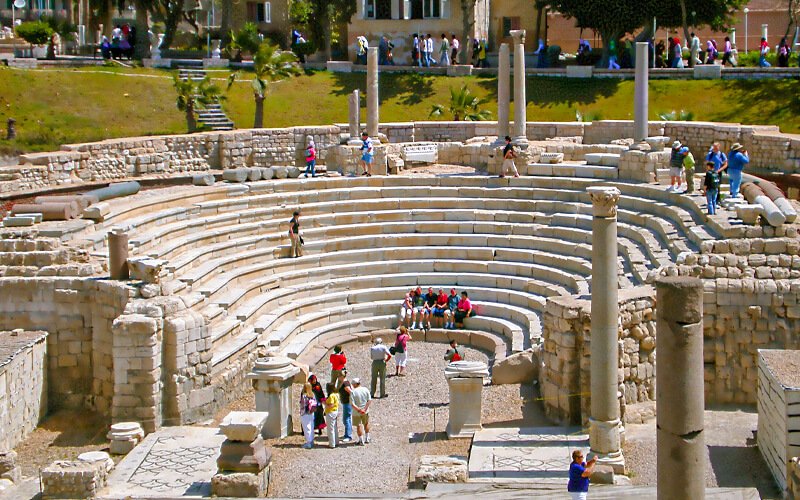
Dating techniques suggest it was built during the reign of Emperor Antoninus Pius or perhaps later under the Byzantine era, showing continuous use across different periods. The site reveals much about ancient Roman architecture in Alexandria, including the precision of the limestone and marble seating, arranged in 13 tiers that could accommodate around 800 spectators.
The location of Kom El Dekka, near the ancient royal quarter and the famous Serapeum of Alexandria, was ideal. It was a thriving neighborhood that reflected the cosmopolitan character of Alexandria Egypt—a city where Egyptians, Greeks, and Romans shared knowledge and traditions. The amphitheater, therefore, wasn’t merely entertainment; it was a symbol of unity in diversity, something that still defines the spirit of the city today.
Visitors often ask, “Why is it called an amphitheater?” The word comes from Greek roots meaning “a place with seating on both sides.” While theater vs amphitheater designs differ, the Roman amphitheater of Alexandria combines elements of both—it’s semi-circular like a Greek theater but includes Roman innovations like an orchestra pit and columned galleries.
Modern-day travelers exploring Alexandria’s historical places can now walk through the same marble steps that once held scholars, musicians, and thinkers. For those seeking an educational and immersive journey, Luxury Trips To Egypt curates special tours that include storytelling, expert guides, and access to rare archaeological insights—offering travelers more than sightseeing, but a connection to Alexandria’s ancient heritage.
Architectural Design and Structure of the Amphitheater
The Roman Amphitheater of Alexandria at Kom El Dekka showcases a brilliant example of ancient Roman architecture that merged artistic precision with structural genius. This amphitheater Alexandria is composed mainly of white and grey marble, forming thirteen semi-circular tiers. Each row was crafted to provide exceptional acoustics, ensuring that even the softest note from the stage could reach the highest seat—a testament to Roman engineering excellence.
The site’s oval layout distinguishes it from typical Greek theaters. Roman amphitheaters were traditionally circular or oval, designed for performances, speeches, and sometimes civic gatherings. Here in Alexandria Egypt, the Roman theater Alexandria followed a more intimate, semi-circular style due to the local topography and the nature of cultural events held there. Unlike the massive arenas used for gladiatorial battles in Rome, the ancient Roman amphitheater Alexandria served as a refined venue for music, poetry, and public dialogue.
Walking through the amphitheater, visitors can see column fragments, marble seats with Greek inscriptions, and the mosaic-paved flooring of what was once a majestic orchestra. Some stones even bear Roman numerals, indicating reserved seating for officials and elites. The central stage area, known as the orchestra, was surrounded by a polished marble floor that reflected light during performances—an ingenious method of illumination in an age before electricity.
Surrounding the theater, archaeologists uncovered remnants of Roman baths, villas, and lecture halls, suggesting this area was once a bustling cultural hub. These structures, together with the amphitheater, form what is now known as the Kom El Dekka archaeological complex. This site provides a unique insight into how Alexandria ancient Rome integrated art, science, and public life into one harmonious environment.
From an architectural standpoint, the Roman amphitheatre Alexandria Egypt demonstrates the versatility of Roman amphitheaters. It reflects not only the mastery of Roman builders but also the multicultural character of Alexandria, a city that blended Egyptian traditions with Hellenistic and Roman innovations. Travelers often compare the amphitheater vs theater design while visiting, appreciating the ingenuity behind the Roman amphitheater’s sound dynamics and sightlines.
For architecture enthusiasts, Luxury Trips To Egypt offers specialized tours focusing on Roman architecture in Alexandria. Expert guides explain how each stone and curve was meticulously shaped to achieve balance, durability, and aesthetic harmony. Standing at the center of the stage, visitors can test the ancient acoustics—speak softly, and the sound travels beautifully to the top seats. It’s a timeless experience that connects modern travelers directly to the engineers and artists of ancient Alexandria.
The Role of the Amphitheater in Ancient Alexandria’s Life
During the height of the Roman Empire, the Roman Amphitheater of Alexandria at Kom El Dekka was not merely a performance venue—it was the beating heart of social and cultural life in the city. As the only Roman amphitheater in Alexandria Egypt, it symbolized the city’s transformation into one of the most vibrant urban centers of the ancient Mediterranean.
Unlike gladiatorial arenas of Rome, this amphitheater roman was used for concerts, oratory competitions, and philosophical debates. Alexandria was a city of thinkers, home to the Great Library and the Museion. Thus, it was fitting that the ancient Roman theater Alexandria served as a gathering place for poets, scholars, and musicians rather than warriors. The amphitheater reflected the city’s intellectual soul and its reputation as a crossroads of knowledge and creativity.
Imagine sitting on the smooth marble benches under the Egyptian sun as musicians performed or philosophers engaged in animated debate. The Roman amphitheatre alexandria was designed to enhance such experiences, providing excellent acoustics for both voice and instruments. Performances often featured a mix of Greek and Roman influences, celebrating Alexandria’s cosmopolitan nature.
The site also played an important civic role. Public announcements, official ceremonies, and imperial proclamations took place within its curved walls. This made it a vital symbol of Roman authority and community unity. The audience represented all social classes—citizens, officials, traders, and visiting foreigners—all gathering to share in the city’s rich cultural fabric.
The Roman theater in Alexandria also hosted celebrations honoring Roman emperors, local festivals, and musical competitions. Such events reinforced Alexandria’s identity as a melting pot of civilizations. Over time, as the city evolved under Byzantine rule, the amphitheater was repurposed for public meetings and performances that reflected the era’s changing tastes.
Today, standing in the center of the Roman amphitheater Alexandria, one can still sense its former grandeur and cultural energy. For modern travelers, Luxury Trips To Egypt recreates that atmosphere with detailed storytelling and immersive guided experiences. Through their tours, visitors gain a deeper understanding of how the ancient amphitheater once resonated with the voices of poets, scholars, and citizens—offering a glimpse into the soul of Alexandria ancient.
The Excavation Journey and Archaeological Significance
The rediscovery of the Roman Amphitheater of Alexandria at Kom El Dekka marked one of the most important archaeological finds of the 20th century in Egypt. The excavation, led by the Egyptian Antiquities Authority and Polish archaeologists in 1960, revealed an unexpectedly well-preserved structure buried under layers of urban debris. What began as a simple construction project turned into an extraordinary journey into Alexandria’s ancient history.
Archaeologists quickly realized they were dealing with a unique Roman theater Egypt—the only known Roman amphitheater in the entire country. Unlike the massive amphitheaters found across Europe, the Roman amphitheatre Alexandria stood out for its elegant design and its multifunctional purpose. It provided key evidence that Alexandria, long celebrated for its Greek heritage, was also deeply influenced by Roman culture.
During excavation, archaeologists uncovered marble seating, Corinthian columns, mosaic floors, and even a section of the Roman baths nearby. The discovery of musical instruments and pottery fragments indicated that the site had hosted performances and possibly private gatherings. Moreover, the remains of the surrounding lecture halls suggested a connection between the amphitheater and Alexandria’s scholarly institutions, such as the Museion—making this site an integral part of the city’s intellectual landscape.
One of the most fascinating finds was a series of inscriptions bearing the names of Roman officials and patrons. These inscriptions provided clues about the amphitheater roman architecture and the people who financed and used it. Archaeologists also noted the structure’s resilience—despite earthquakes and centuries of erosion, the amphitheater retained much of its original form.
Today, the excavation area continues to be a living laboratory for archaeologists and historians. It offers insights into Roman Alexandria and its social dynamics, urban planning, and architectural innovation. Visitors can still see partially reconstructed sections of the ancient Roman amphitheater Alexandria, along with artifacts displayed in nearby museums.
For travelers who love archaeology, Luxury Trips To Egypt offers guided tours that include behind-the-scenes insights into how this incredible site was uncovered and restored. These tours reveal how the Roman amphitheatre egypt connects to the broader story of Alexandria’s evolution—from the era of Alexander the Great through the Roman Empire and beyond.
Visiting the Roman Amphitheater Today — What to Expect
A visit to the Roman Amphitheater of Alexandria at Kom El Dekka is one of the most rewarding experiences in Alexandria Egypt. Located near the city center, it’s easily accessible and often included among the top Alexandria tourist attractions. The site offers a tranquil yet inspiring atmosphere where travelers can literally walk through history.
Upon entering, visitors are greeted by the impressive semicircular tiers of marble seating. The amphitheater’s compact scale makes it easy to explore. Climb to the top rows for a panoramic view of Alexandria, or stand at the center of the stage to test the legendary acoustics. Even a whisper carries across the space, a reminder of the Roman mastery of sound design.
The Kom El Dekka archaeological complex also includes remnants of Roman baths, villas, and a small museum displaying artifacts discovered on-site. These provide valuable context about daily life in ancient Alexandria. Visitors often enjoy combining their tour of the amphitheater with nearby attractions such as the Catacombs of Kom El Shoqafa, the Alexandria Library (Bibliotheca Alexandrina), and the Pompey’s Pillar—making it an ideal day trip for anyone exploring things to do in Alexandria Egypt.
Photography enthusiasts will appreciate how the marble structures capture the changing light throughout the day. The site’s peaceful surroundings contrast beautifully with the bustling streets of modern Alexandria, offering a serene space to reflect on the city’s layered history.
To make the most of your visit, booking through Luxury Trips To Egypt ensures a smooth, well-organized experience. The agency provides expert guides who share fascinating historical details and hidden stories about the Roman amphitheatre alexandria egypt. They also offer personalized itineraries combining Alexandria sightseeing with cultural and culinary experiences, ensuring travelers discover both ancient wonders and modern Egyptian hospitality.
For travelers wondering what to do in Alexandria, the Roman theater Alexandria is a must-see. It’s more than a historical monument—it’s a living testimony to a civilization that celebrated knowledge, beauty, and creativity.
Nearby Attractions and Things to Do in Alexandria, Egypt
Beyond the Roman Amphitheater of Alexandria at Kom El Dekka, the city offers countless attractions that showcase its ancient charm and Mediterranean soul. As one of Egypt’s most fascinating coastal cities, Alexandria seamlessly blends history, culture, and relaxation.
Just a short distance from the amphitheater lies Pompey’s Pillar, a towering Roman column built in honor of Emperor Diocletian. Nearby are the Catacombs of Kom El Shoqafa, one of the Seven Wonders of the Middle Ages, where Greco-Roman art meets ancient Egyptian tradition. For travelers interested in architecture, the Qaitbay Citadel, standing on the site of the ancient Lighthouse of Alexandria, offers panoramic sea views and a deep connection to Alexandria’s maritime heritage.
Modern Alexandria attractions include the Bibliotheca Alexandrina, a world-class cultural center and modern revival of the ancient Library of Alexandria. Visitors can also stroll along the Corniche, explore the Royal Jewelry Museum, or relax at Stanley Bridge overlooking the Mediterranean.
Whether you’re exploring places to visit in Alexandria Egypt or seeking things to see in Alexandria, the city has something for everyone. Couples enjoy romantic walks by the sea, history enthusiasts marvel at ancient ruins, and families discover hidden gems within the city’s vibrant neighborhoods.
Travelers booking with Luxury Trips To Egypt can enjoy curated experiences that connect these attractions into seamless journeys—combining visits to the Roman amphitheater Alexandria, historical sites, and authentic local dining spots. The agency’s professional guides ensure that every traveler leaves with unforgettable memories and a deeper understanding of Alexandria’s unique blend of Greek, Roman, and Egyptian heritage.
Tips for Travelers and How Luxury Trips To Egypt Enhances the Experience
Exploring Alexandria Egypt and its treasures like the Roman Amphitheater of Alexandria at Kom El Dekka becomes even more meaningful with the right guidance. Here are essential tips to make the most of your trip.
Best Time to Visit:
The best months to visit Alexandria are from March to May and September to November, when the weather is pleasant and the crowds are smaller.
Getting There:
Alexandria is about three hours by road from Cairo. Many tours offered by Luxury Trips To Egypt include comfortable transfers, expert guides, and optional stops at scenic locations along the way.
Entrance & Etiquette:
The site is open daily, and photography is allowed. However, travelers are encouraged to respect the historic surroundings—avoid climbing on ancient structures and follow local guidelines.
Why Choose Luxury Trips To Egypt:
This travel agency is renowned for crafting personalized, high-quality tours across Egypt. Whether exploring the Roman amphitheatre, cruising the Nile, or visiting the pyramids, their expert team ensures comfort, knowledge, and authenticity. With Luxury Trips To Egypt, travelers experience not just the monuments but the stories, people, and culture behind them.
By booking with Luxury Trips To Egypt, you’ll have access to private guided tours, multilingual experts, and curated itineraries that blend history with leisure. Their mission is to make every visit enriching and smooth—from the first inquiry to the final farewell.
Cultural Impact and Global Importance of the Site
The Roman Amphitheater of Alexandria at Kom El Dekka is not only a cornerstone of Egypt’s Roman heritage, but also a monument that connects continents and cultures. As the only surviving Roman amphitheater in Egypt, it offers a tangible link between the grandeur of ancient Rome and the intellectual brilliance of Alexandria ancient.
This site reminds the world that Alexandria was more than a city—it was a symbol of knowledge, dialogue, and diversity. The amphitheater served as a venue where art met science, and where different civilizations interacted harmoniously. Today, scholars consider it a living classroom, teaching visitors about the amphitheater roman architecture, cultural exchange, and the endurance of human creativity.
Its preservation also underscores Egypt’s commitment to protecting its multi-layered history. Through restoration and tourism, sites like this inspire travelers to value cultural heritage. For international visitors, the Roman amphitheatre Alexandria stands as proof of how art and history transcend borders.
By promoting responsible tourism and awareness, Luxury Trips To Egypt contributes to this cultural legacy—ensuring future generations can continue to experience the wonder of ancient Roman theater Alexandria in its authentic form.
Conclusion — Preserving the Roman Heritage of Alexandria
The Roman Amphitheater of Alexandria at Kom El Dekka stands as a timeless symbol of Alexandria’s multicultural spirit and historical depth. It’s more than just a ruin—it’s a bridge between eras, connecting modern travelers to the ancient world. Every stone tells a story of creativity, knowledge, and community, reminding us that Alexandria Egypt was once one of the greatest cities of civilization.
For travelers planning to explore things to do in Alexandria Egypt, this site should top your list. Standing where Roman citizens once gathered, you can almost hear echoes of ancient music and laughter that once filled this marble arena.
With the help of Luxury Trips To Egypt, visitors can transform a simple tour into a journey through time—one that combines expert storytelling, historical insight, and Egyptian hospitality. The Roman amphitheater Alexandria remains one of the best-preserved symbols of Roman Alexandria, a site that continues to inspire awe in everyone who visits.
Whether you’re a history lover, photographer, or curious traveler, this magnificent ancient Roman amphitheater Alexandria invites you to step back into the days when Alexandria was the cultural heart of the ancient world—and rediscover its magic for yourself.