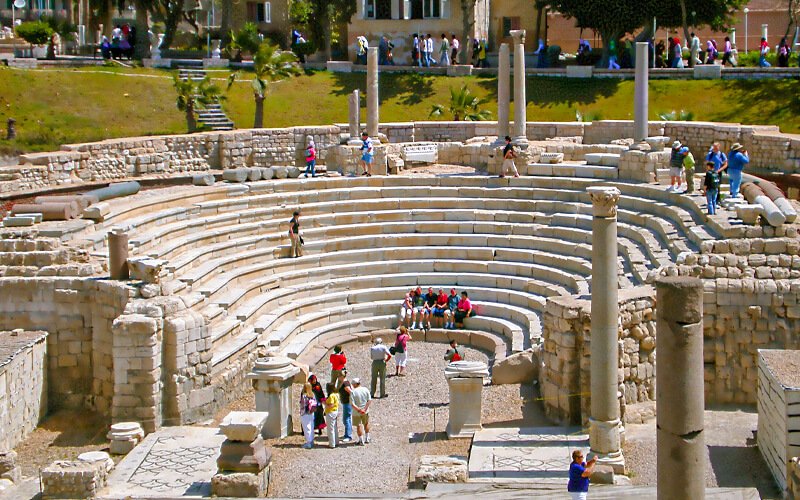
The Alexandria Roman Theatre stands as one of Egypt’s most fascinating archaeological landmarks, revealing layers of history that blend Egyptian, Greek, and Roman influences. Known locally as Kom El Dikka, this site offers travelers a rare chance to step into the ancient world. For centuries, the city of Alexandria has been a crossroads of civilizations — a place where philosophers, rulers, and artists shaped the course of Mediterranean history. The Roman Theatre is one of the few surviving monuments that embody this golden era.
This ancient Roman theatre in Alexandria dates back to the 2nd century AD during the Roman period when the city flourished as a cultural capital of the empire. With its marble seats, semicircular structure, and acoustically perfect design, it remains a remarkable example of Greco-Roman architecture. The question many travelers ask is: “This is the ancient Roman theatre of Kom El Deka in Alexandria in which country?” — and the answer is proudly Egypt, a land that holds countless remnants of world heritage.
The Roman amphitheatre Alexandria isn’t merely an archaeological site; it’s a living memory of performances, public gatherings, and imperial ceremonies. Visitors today can still sense the grandeur of its curved marble benches and the elegance of the colonnades that once surrounded it. Whether you’re a historian, a traveler seeking culture, or someone simply curious about ancient wonders, the Alexandria Roman Theatre offers a profound journey through time — and Luxury Trips To Egypt ensures your exploration is unforgettable, guided by experts who bring this history vividly to life.
Where Is the Ancient Roman Theatre of Kom El Dikka in Alexandria?
Many travelers often wonder, “This is the ancient Roman theatre of Kom El Deka in Alexandria in which country?” The answer is simple: Egypt, located in the heart of Alexandria — one of the oldest and most vibrant cities along the Mediterranean coast. The Kom El Dikka area, whose name literally means “Mound of Rubble” or “Hill of Debris,” became famous after the discovery of the Roman Theatre during the 1960s. The dikka meaning symbolizes the layered history buried beneath Alexandria’s modern streets.
The Roman theatre of Kom El Dikka lies near the city center, between the railway station and the harbor. Its accessibility makes it one of the easiest ancient sites to visit in Egypt. Tourists often confuse amphitheatres and theatres, so it’s useful to know the amphitheater meaning: an amphitheatre is circular and used for gladiator games, while a theatre is semicircular, built mainly for performances and speeches. Thus, what stands in Kom El Dikka is technically a theatre, though many refer to it as an amphitheatre due to its Roman design influences.
Surrounded by remnants of ancient villas, cisterns, and lecture halls, the Roman Theatre Alexandria Egypt serves as the core of a larger archaeological park that once housed the Roman baths and the Villa of the Birds, famous for its colorful mosaics. Modern travelers visiting with Luxury Trips To Egypt enjoy walking among these ruins while guides narrate the site’s transformation from a cultural hub to an archaeological wonder. The Alexandria Roman amphitheatre is more than stone and marble — it is a symbol of Egypt’s eternal connection to Mediterranean civilization.
History of the Roman Theatre in Alexandria
The history of the Roman Theatre Alexandria begins in the 2nd century AD during the reign of Emperor Antoninus Pius. It was built at a time when Alexandria stood as a vital cultural and economic center of the Roman Empire. The structure served as a venue for musical performances, poetry readings, and civic events. Over time, earthquakes and shifting sands concealed the theatre until archaeologists rediscovered it in 1960 during excavations led by the Polish-Egyptian mission.
Unlike other Roman theaters found across the empire, such as those in Rome or Ephesus, the Alexandria ancient Roman theater reflects a fusion of Egyptian and Greco-Roman architectural styles. The Greek and Roman theater traditions influenced its semicircular seating, while local Egyptian craftsmanship added unique artistic touches. During its peak, it accommodated approximately 800 spectators — fewer than grand amphitheaters, but perfect for cultural performances and philosophical gatherings.
The Roman theatre of Kom El Dikka later transformed during the Byzantine era into an auditorium used for public debates. This evolution mirrors Alexandria’s intellectual heritage as a city of learning, home to the legendary Library of Alexandria. For history enthusiasts, the ancient Roman theatre of Kom El Deka in Alexandria represents not only architectural brilliance but also the continuity of Alexandria’s role as a hub of art and philosophy. To explore this historical treasure, Luxury Trips To Egypt offers curated tours combining the theatre with the Graeco-Roman Museum Alexandria, giving visitors a complete perspective of Alexandria’s ancient legac
Architecture and Structure: Inside the Roman Amphitheatre
The architecture of the Alexandria Roman Theatre is a masterpiece that reveals the engineering brilliance of the Roman Empire. Built from white and gray marble, the theatre’s design follows the classical Greco-Roman amphitheatre layout but with unique Egyptian touches. It features thirteen semicircular tiers of marble seating arranged in a horseshoe shape, perfectly designed for acoustics and visibility. Each row of seats was carefully crafted to allow sound to travel naturally from the stage to the audience without amplification — a testament to the advanced engineering skills of ancient builders.
At the heart of the structure lies the orchestra, a semicircular performance space paved with marble slabs. Behind it stood the skene, or stage building, once adorned with ornate columns and statues. While most Roman theaters in the empire were open-air venues, the Alexandria ancient Roman theater might have been partially covered to protect spectators from the Mediterranean weather. Scholars often compare this site to other monumental structures like the Roman amphitheater in Ephesus or the Greek and Roman theatre in Athens, but the Alexandria version stands out for its smaller, intimate design and refined aesthetic.
Visitors today can still see traces of the columns and decorative carvings that once graced the stage area. The marble steps bear signs of restoration, yet they retain the authenticity of their original craftsmanship. Unlike many other sites in Egypt, the Kom El Dikka Roman Theatre Alexandria allows tourists to walk through the very seats where ancient spectators once sat. It’s a rare opportunity to experience both history and architecture firsthand.
Understanding the difference between theatre and amphitheatre helps visitors appreciate this site more deeply. A theatre, such as the Roman Theatre Alexandria, was semicircular and dedicated to performances, while an amphitheatre was circular, built mainly for gladiatorial games. Thus, the Alexandria Roman Amphitheatre Egypt, though sometimes called an amphitheatre, is truly a theatre by design. When you book through Luxury Trips To Egypt, expert guides ensure you grasp these fascinating distinctions while exploring the stunning stonework of Kom El Dikka.
Cultural and Political Role During the Roman Period
The Roman Theatre in Alexandria wasn’t just an architectural landmark — it was a stage for cultural, social, and political life. In Roman Egypt, theatres played a key role in spreading imperial ideology and providing entertainment. The Roman period theater served as a venue for public gatherings, musical performances, philosophical debates, and sometimes political announcements. The Roman amphitheater purpose extended beyond art — it symbolized unity under the empire and displayed the grandeur of Roman civilization in Egypt.
During the 2nd and 3rd centuries AD, the theatre would host plays inspired by Greek tragedies and Roman comedies. Actors performed in elaborate costumes, musicians played instruments like the lyre, and poets recited verses that reflected both local and imperial themes. These events attracted citizens from all social classes — from scholars and merchants to Roman officials. The atmosphere in the ancient Roman theatre Alexandria would have been vibrant and intellectual, reflecting the city’s role as a cultural hub.
In later centuries, the theatre adapted to new purposes. During the Byzantine era, parts of the structure were used for public lectures and ceremonies, while others may have hosted council meetings. This versatility demonstrates how Alexandrian society evolved with time. Today, when visiting the Roman Theatre of Kom El Dikka, travelers can imagine how these gatherings shaped public life over nearly a thousand years.
For modern visitors, understanding this cultural significance enriches the experience. As you walk through the marble rows with Luxury Trips To Egypt, guides explain how the site once echoed with applause, debate, and celebration. The Alexandria Roman Theatre thus serves as both a symbol of Roman influence and a reminder of Alexandria’s enduring role as Egypt’s beacon of knowledge and art.
Discovery and Excavation of Kom El Dikka
The rediscovery of the Roman Theatre Alexandria Egypt is one of the most exciting archaeological stories in modern times. For centuries, the structure lay hidden beneath layers of sand and urban debris in Kom El Dikka Alexandria, an area once known for residential neighborhoods. In 1960, during routine construction for new government buildings, workers accidentally uncovered marble columns and circular stone structures. The discovery attracted archaeologists, and soon the Polish-Egyptian Archaeological Mission began a full-scale excavation under the direction of Kazimierz Michałowski.
Over several decades, archaeologists uncovered not only the theatre but also an entire archaeological complex — including Roman baths, cisterns, lecture halls, and mosaic-floored villas. The site revealed a miniature city from the Greco-Roman era. The Roman Theatre of Kom El Dikka became the centerpiece, its preserved marble seating making it one of the best-maintained examples in North Africa.
Excavations revealed fascinating artifacts: coins, pottery, and sculptures, all pointing to the site’s prominence during Alexandria’s Roman and Byzantine periods. Researchers believe the theatre may have been repurposed multiple times, serving as a public meeting space, musical hall, and even a government auditorium. These findings make Kom El Dikka Roman Theatre Alexandria not just an isolated monument but a window into daily life in ancient Alexandria.
Today, thanks to these efforts, the site is fully accessible to the public. Luxury Trips To Egypt includes Kom El Dikka in its exclusive Alexandria city tours, where visitors can explore the theatre, photograph its structure, and walk through the ancient Roman theater Alexandria remains that connect Egypt’s past with its present.
The Relationship Between Alexandria and Rome
To understand the Alexandria Roman Theatre, one must appreciate the deep connection between Rome and Alexandria. After Egypt became a Roman province in 30 BCE, Alexandria emerged as a vital link between the East and West. The city’s harbor was one of the busiest in the empire, and its intellectual scene flourished under Roman patronage. The Greco-Roman architecture seen in Kom El Dikka reflects this cultural blending — columns with Corinthian capitals, mosaic art with Roman designs, and Egyptian symbolism carved into stone.
The Greco-Roman amphitheatre stands as a physical representation of this fusion. It merged Greek theatre aesthetics with Roman functionality, creating a structure suited for Alexandria’s cosmopolitan audience. Artists from different backgrounds performed there, and philosophers debated ideas influenced by both Eastern mysticism and Western rationalism. The Greek and Roman theatre traditions coexisted in harmony, symbolizing the unity of civilizations under Roman rule.
This period also saw Alexandria rise as a center for education, housing scholars who studied astronomy, medicine, and philosophy. The theatre may have even hosted public lectures, continuing the city’s scholarly legacy. The Graeco-Roman Museum Alexandria, located nearby, preserves artifacts from this era, including statues and inscriptions that reference the theatre and its patrons.
For modern travelers, this connection enriches every visit. Walking through Kom El Dikka with Luxury Trips To Egypt, visitors gain insight into how two great empires — Greek and Roman — merged their artistic and architectural ideals on Egyptian soil. The result was not only the Roman Theatre Alexandria but also the foundation of a cultural identity that continues to define the city today.
Modern Restoration and Preservation Efforts
Preserving the ancient Roman Theatre of Kom El Dikka in Alexandria has been a priority for Egyptian authorities and international archaeologists. Since its discovery, numerous restoration projects have ensured that this ancient structure remains accessible and safe for visitors. Specialists used marble and limestone identical to the original materials to maintain authenticity, while protective barriers and drainage systems prevent erosion from Alexandria’s humid climate.
The site has been carefully cleaned and stabilized to highlight its natural beauty without modern interference. Restoration teams from Egypt and Poland have worked jointly to reconstruct damaged seating and restore the stage’s architectural details. These efforts transformed the site into a cultural venue, occasionally hosting small concerts and academic gatherings that revive the spirit of the ancient performances once held there.
Moreover, digital preservation initiatives now document the Roman Theatre Alexandria in 3D for educational and research purposes. This ensures that future generations can explore the site virtually and understand its importance. The ancient Roman amphitheater Alexandria stands today not only as a ruin but as a living museum — a place where history is celebrated daily.
Travelers visiting with Luxury Trips To Egypt witness firsthand the care taken to protect this monument. Guides explain the engineering methods behind the restoration and the collaboration between Egypt’s Ministry of Antiquities and international experts. Visiting the Alexandria Roman Theatre today means seeing both the past and the future of archaeology come together in one stunning location.
Visitor Experience: What to Expect at the Site
A visit to the Roman Theatre in Alexandria offers an unforgettable experience for history lovers, photographers, and curious travelers alike. As you step through the entrance, the marble steps gleam under the Mediterranean sun, and the air carries the faint echo of ancient performances. Standing at the center of the orchestra, one can test the acoustics by speaking softly and hearing the sound travel seamlessly — proof of Roman engineering perfection.
Visitors can walk among the marble benches, explore the surrounding ruins, and admire ancient columns that once formed the theatre’s decorative backdrop. Nearby lies the Villa of the Birds, showcasing mosaics of exotic species that once adorned the homes of Alexandria’s wealthy citizens. The site’s tranquil atmosphere makes it a favorite for those seeking to connect with the city’s ancient soul.
Photography enthusiasts will find the Alexandria ancient Roman theater photos particularly captivating at sunrise or sunset, when golden light touches the marble. Signboards throughout the site explain the amphitheater meaning, architectural features, and historical significance in multiple languages. For travelers who value comfort and depth, booking through Luxury Trips To Egypt ensures guided storytelling, transport, and exclusive insights into the theatre’s legacy.
Beyond the ruins, visitors can explore nearby attractions like the Graeco-Roman Museum, the Alexandria Library, and the Qaitbay Citadel. Together, these landmarks paint a full picture of Alexandria’s evolution from ancient times to modern Egypt. The Roman amphitheater Alexandria is not just a stop on a tour — it’s a timeless experience of art, history, and civilization.
Nearby Attractions Around Kom El Dikka
The Kom El Dikka area is surrounded by historical and cultural treasures that make it one of the most rewarding destinations for travelers in Egypt. Just a short walk away stands the Graeco-Roman Museum Alexandria, home to statues, coins, and relics that contextualize the theatre’s role in ancient life. Visitors can also explore the theatre in Egypt exhibits, which display models of other Roman sites across the country, such as the Roman theatre Ismailia Egypt and the Roman theatre Sharm El Sheikh.
Not far from the theatre lies the Alexandria Library (Bibliotheca Alexandrina) — a modern tribute to the ancient library that once symbolized global knowledge. The Pompey’s Pillar, another iconic site, stands proudly nearby, offering panoramic views of the city. For those interested in religious history, the Catacombs of Kom El Shoqafa provide a mysterious underground glimpse into Greco-Roman funerary practices.
Travelers exploring with Luxury Trips To Egypt often enjoy curated itineraries that include all these landmarks. These tours allow you to explore Kom El Dikka Roman Theatre Alexandria, photograph its beauty, and continue your journey through Alexandria’s vibrant history. From ancient ruins to modern marvels, this district connects all eras of Egyptian heritage, making it an essential stop for any traveler.
Plan Your Trip with Luxury Trips To Egypt
For those eager to discover the Alexandria Roman Theatre, planning your journey with Luxury Trips To Egypt guarantees a seamless and enriching experience. As Egypt’s leading travel agency, Luxury Trips To Egypt specializes in crafting historical and cultural tours that go beyond ordinary sightseeing. With expert Egyptologists, private transportation, and flexible itineraries, travelers can explore Kom El Dikka, the Roman Theatre, and other Alexandrian gems in comfort and style.
The agency’s carefully designed Alexandria day tours often include visits to the Roman amphitheatre Alexandria Egypt, Pompey’s Pillar, Qaitbay Citadel, and the Library of Alexandria. For those who wish to dive deeper, multi-day packages link Alexandria with Cairo, Luxor, and Aswan, creating a full journey through Egypt’s millennia of civilization. Travelers receive personalized attention, local insights, and guided storytelling that transforms every step into a meaningful experience.
Whether you’re a historian, photographer, or first-time visitor, Luxury Trips To Egypt ensures that exploring the Roman Theatre Alexandria becomes a highlight of your journey. From entry tickets to transport and expert narration, everything is handled with precision and care. Visiting this site through the agency means not only seeing history — but truly understanding it.
Conclusion: Why the Alexandria Roman Theatre Should Be on Every Traveler’s List
The Alexandria Roman Theatre stands as one of the most fascinating archaeological sites in Egypt — a bridge between cultures, empires, and eras. Located in Kom El Dikka Alexandria, it tells a story that stretches from the height of the Roman Empire to modern Egypt’s proud heritage. Visitors who ask, “This is the ancient Roman theatre of Kom El Deka in Alexandria in which country?” discover that the answer, Egypt, holds far more than pyramids and temples; it preserves living echoes of art, performance, and philosophy.
From its elegant marble seats to its stunning acoustics, every corner of the Roman Theatre of Kom El Dikka reflects the creativity and brilliance of ancient builders. Its preservation today allows travelers from around the world to experience a piece of history that continues to inspire admiration and wonder. For those seeking to explore this timeless monument with comfort, expertise, and cultural depth, Luxury Trips To Egypt remains the best travel agency in Egypt — offering guided experiences that turn history into memory.
So, whether you’re wandering through the curved tiers of marble, capturing the golden light of Alexandria, or imagining the performances once held here, the ancient Roman theatre Alexandria invites you to connect with a world that once defined civilization itself. Let the echoes of history guide your steps — and let Luxury Trips To Egypt lead you there.