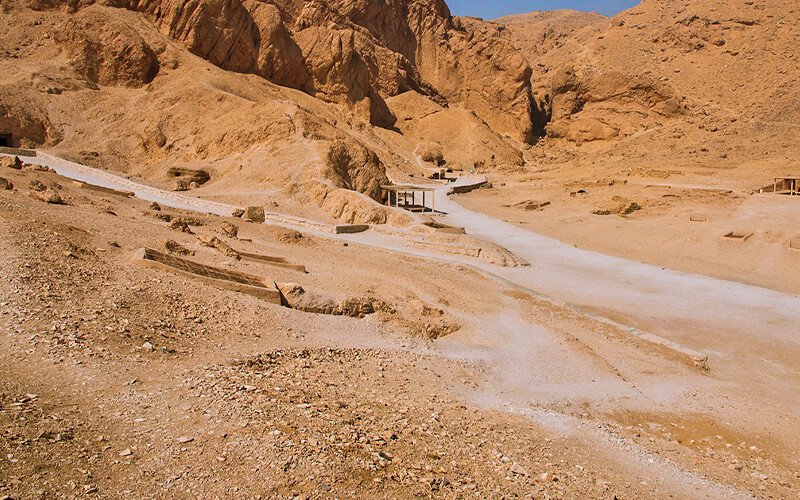
Location and Historical Overview
Nestled in a quiet desert basin west of Luxor, the Valley of the Queens forms part of the vast Theban Necropolis. Known in ancient times as Ta-Set-Neferu, meaning “The Place of Beauty,” this sacred area was selected for its serene surroundings and its connection to the afterlife. The Valley of Queens in Luxor was the chosen burial site for queens of the 18th to 20th dynasties (1550–1070 BCE), along with their children and high-status women from the royal court.
The valley of queens Egypt was designed to provide eternal peace to these women, ensuring their souls could unite with the gods. Its proximity to the Valley of the Kings symbolized balance — just as the sun sets in the west, so too did life transition into eternity in these western valleys. Over 90 tombs have been discovered here, ranging from small chambers to elaborately decorated royal shrines.
Unlike the grand, hidden corridors of the pharaohs’ tombs, the tombs in the valley of the queens emphasize beauty, devotion, and divine rebirth. Each wall painting, hieroglyph, and carved relief tells a story of love, motherhood, and the afterlife. Standing amid the cliffs of Luxor Valley of the Queens, visitors can feel the profound stillness that once enveloped ancient rituals of burial and remembrance.
For modern travelers, the Valley of the Queens map reveals an intricate network of tombs carved deep into the limestone, accessible by winding desert paths. This extraordinary landscape, though less famous than the royal valleys, offers a more personal and emotionally resonant experience — one that connects you directly to the women who shaped Egypt’s history.
The Role of the Queens in Ancient Egypt
The Valley of the Queens exists as a tribute to the importance of royal women in ancient Egypt’s social and spiritual structure. Queens were not merely wives of kings; they were priestesses, mothers of heirs, and sometimes rulers in their own right. They were seen as earthly reflections of goddesses such as Hathor, Isis, and Mut — divine protectors of life, fertility, and rebirth.
During the New Kingdom, queens like Nefertari, Tiye, and Teye were deeply involved in both political and religious life. Their tombs reflect this elevated status. In the Valley of the Queens Egypt, the artwork emphasizes their divine connection rather than their worldly achievements. The queens are shown in scenes of worship, embraced by deities, or journeying through the underworld guided by protective gods.
For travelers exploring the Valley of the Queens Egypt, these tombs provide a powerful sense of reverence. The artistry goes beyond decoration — it represents faith and transformation. The queens sought eternal unity with Osiris, ruler of the afterlife, while maintaining their maternal and royal dignity.
This valley, often called the Queens Valley Luxor, symbolizes love and devotion between kings and their royal consorts. The pharaohs ensured their beloved wives would have a peaceful and honored afterlife by choosing this beautiful, secluded location. Today, walking through the Valley of Queens Luxor, you can sense the same admiration — the valley still whispers stories of affection, loyalty, and the grandeur of ancient Egyptian womanhood.
Notable Tombs in the Valley of the Queens
More than 90 tombs have been discovered in the Valley of the Queens Luxor Egypt, though only a few are open to visitors due to preservation efforts. Each tomb tells a story of a queen’s journey to the afterlife and her connection to the gods. Among these, several stand out for their beauty and historical importance.
The Tomb of Queen Nefertari (QV66)
Undoubtedly the crown jewel of the Valley of the Queens tombs, this masterpiece was built for Nefertari, the beloved wife of Pharaoh Ramses II. Her tomb is celebrated for its extraordinary wall paintings — vibrant, well-preserved, and filled with symbolism. Every surface glows with images of Nefertari accompanied by deities, passages from the Book of the Dead, and celestial motifs representing eternal life. The Nefertari tomb is often described as the “Sistine Chapel of Ancient Egypt.”
The Tomb of Prince Khaemwaset
This tomb was built for one of Ramses III’s sons. Though less decorated than Nefertari’s, it gives visitors a fascinating insight into royal funerary customs and the artistic evolution of the period.
The Tomb of Queen Tyti
Queen Tyti’s tomb is another gem in the Valley of Queens Luxor, noted for its colorful depictions of rituals and gods welcoming her into the afterlife. The graceful scenes and hieroglyphs evoke the serenity of eternal peace.
The Tomb of Amunherkhepshef
Amunherkhepshef was a royal child of Ramses III. His tomb features touching scenes of a young prince guided by his father and protected by deities. It’s one of the most popular tombs open to visitors today.
Every tomb in this valley — whether that of a queen, prince, or princess — reveals the artistic mastery and deep spirituality of Egypt’s royal families. The Valley of the Queen continues to stand as a timeless tribute to those who lived and loved under the shadow of the gods.
The Tomb of Queen Nefertari – A Masterpiece of Art
No discussion of the Valley of the Queens is complete without celebrating the Tomb of Queen Nefertari, one of the most exquisite creations of ancient art ever discovered. Nefertari, meaning “the most beautiful of them all,” was the cherished wife of Ramses II. Her tomb (QV66) captures both her grace and her spiritual journey.
Discovered in 1904 by Italian archaeologist Ernesto Schiaparelli, Nefertari’s tomb astonished the world with its vivid colors and perfect preservation. The paintings depict her as both queen and goddess, wearing elaborate crowns, white linen garments, and gold jewelry. Each wall narrates her passage through the underworld, protected by the gods and goddesses she once worshipped on earth.
What sets this tomb apart is its artistry — the precision of the brushwork, the harmony of color, and the emotion conveyed in every gesture. The ceiling, painted deep blue with golden stars, represents the heavens under which her soul eternally resides. The sekhmet tomb valley of the queens nearby also honors divine feminine power, but none rival Nefertari’s for beauty and depth.
Due to its fragility, access to Nefertari’s tomb is limited, and tickets are sold separately. However, many travelers describe the experience as once-in-a-lifetime. Standing in front of those glowing walls, you feel the presence of a woman who transcended time — her beauty, intelligence, and devotion preserved for over three millennia.
For any traveler visiting the Valley of the Queens Luxor Egypt, this tomb is the highlight — a testament to love, art, and the eternal bond between mortals and the divine.
Architecture and Symbolism of the Tombs
The architecture of the Valley of the Queens Egypt reflects a blend of precision and spirituality. Unlike the grand, labyrinthine tombs of the pharaohs, these resting places focus on intimacy and detail. Most tombs feature a main hall, side chambers, and a burial chamber adorned with symbolic motifs representing rebirth and divine protection.
The valley of the queens tombs were designed to guide the soul safely into the afterlife. The walls feature sacred texts, solar disks, and hieroglyphic spells that ensured the queen’s journey through the underworld was successful. Goddesses such as Hathor, Isis, and Ma’at appear frequently, offering protection and renewal.
The vibrant colors were created using natural minerals like malachite and ochre, mixed with egg or plant resin to endure thousands of years. Every brushstroke carried meaning: blue represented the heavens, green symbolized fertility and rebirth, and gold denoted divinity. These artistic choices make the valley queens tombs some of the most visually stunning monuments in the world.
Interestingly, the Valley of the Kings and Queens share architectural similarities, but the queens’ tombs reveal a softer, more emotional touch. The focus is on love, motherhood, and spiritual transformation rather than royal conquest. The queen valley Egypt thus stands as a testament to the divine feminine and to the artistry that flourished under Egypt’s golden dynasties.
The Goddesses and Beliefs Represented in the Tombs
The Valley of the Queens is not only a burial site but also a sacred space where divine beliefs come to life through art. The tombs are adorned with symbols of goddesses who guarded and guided the queens on their journey beyond death. These figures embody Egypt’s deep reverence for feminine divinity and balance in the cosmic order.
Among them, Hathor, goddess of love and motherhood, appears frequently, welcoming the queens into the afterlife. Isis, sister-wife of Osiris, symbolizes protection and eternal life. Sekhmet, the lioness goddess of power, is depicted as a fierce guardian ensuring that no evil could disturb the tombs. The Sekhmet tomb Valley of the Queens is particularly noted for its depictions of her strength and majesty.
Other deities such as Nephthys and Ma’at represent truth, harmony, and justice — virtues that every Egyptian sought to embody in life and death. The combination of these divine presences transforms the Valley of Queens Egypt into a spiritual masterpiece, uniting art and theology.
For modern visitors, understanding these symbols enhances the experience. As you walk through the Luxor Valley of the Queens, you are surrounded by depictions of rebirth, protection, and eternal peace. It’s a reminder that these tombs were more than burial chambers; they were gateways to eternity, created by a civilization that saw life and death as a continuous journey of the soul.
Visiting the Valley of the Queens Today
Visiting the Valley of the Queens Luxor today is a captivating experience that connects travelers with Egypt’s ancient past in a quiet, reflective setting. Located about 25 minutes from central Luxor, the site is accessible by car, taxi, or organized tours.
Entry tickets can be purchased at the main ticket office near the entrance to the Theban Necropolis. Visitors can explore several open tombs, including those of Queen Tyti, Prince Amunherkhepshef, and, with a special ticket, Queen Nefertari. To protect the paintings, photography is often restricted, so it’s best to bring a notebook or simply absorb the experience visually.
The Valley of the Queens photos found online only capture a fraction of the beauty visible in person. The natural light shifting across the desert landscape, the cool air inside the tombs, and the silence of the surrounding cliffs create an atmosphere of sacred stillness.
For travelers using a Valley of the Queens map, it’s easy to combine this visit with nearby attractions such as the Valley of the Kings, the Temple of Hatshepsut, and Medinet Habu. Whether you explore independently or join a guided tour, having an Egyptologist explain the symbols and hieroglyphs adds enormous depth to your visit.
Walking through this valley of the queen Egypt, you experience more than history — you encounter art, faith, and eternal love immortalized in stone. It’s a place that quietly stirs the imagination and invites reflection on the grandeur of human belief and creativity.
Valley of the Queens vs. Valley of the Kings
Travelers often wonder about the differences between the Valley of the Queens and the Valley of the Kings. Both sites belong to the same necropolis, but each served a unique purpose in the afterlife beliefs of ancient Egypt. The Valley of the Kings was reserved for pharaohs and elite male rulers, while the Valley of the Queens Egypt honored royal women and children.
The Valley of the Kings and Queens together form a powerful narrative of Egyptian civilization — one of balance between masculine and feminine energies, power and compassion, governance and grace. The kings’ tombs are grand, with deep corridors, while the queens’ tombs emphasize elegance, artistry, and spiritual tenderness.
For travelers, visiting both valleys reveals the full picture of Thebes’ royal legacy. The Valley of the Queens Luxor offers fewer crowds and a more tranquil experience, allowing you to connect deeply with the artistry and symbolism. When compared side by side, the queens valley Luxor radiates intimacy, while the kings’ valley radiates grandeur. Together, they embody the essence of Egypt’s ancient pursuit of immortality.
Travel Tips: Best Time to Visit and How to Get There
If you’re planning a journey to Luxor, the Valley of the Queens should be an essential stop. The best time to visit is between October and April, when temperatures are comfortable for exploring. Early morning or late afternoon visits offer cooler weather and softer sunlight, perfect for appreciating the valley’s colors.
Getting There
You can reach the Valley of Queens in Luxor via taxi, private car, or as part of an organized tour. Many travelers prefer booking through a local travel agency to ensure seamless transportation and expert guidance.
What to Bring
Comfortable walking shoes, water, and light clothing are essential. The desert sun can be strong, so sunscreen, hats, and sunglasses are recommended.
Nearby Attractions
Combine your visit with nearby sites like the Temple of Hatshepsut, Colossi of Memnon, and Medinet Habu. Each adds context to your understanding of the ancient Theban landscape.
Using a Valley of the Queens Egypt map helps plan your visit efficiently. Whether you’re a history enthusiast or a curious traveler, a guided experience ensures you don’t miss key details hidden within the tombs.
Why Add the Valley of the Queens to Your Egypt Itinerary
The Valley of the Queens is more than a historical site — it’s a poetic tribute to love, beauty, and devotion. Visiting it allows travelers to see a gentler side of ancient Egypt, one that celebrates femininity and faith rather than conquest and power.
For those who wish to experience Egypt beyond the famous monuments, this valley offers a personal connection to the individuals who lived behind the grandeur of the pharaohs. Every brushstroke and carving reveals a human story — of family, love, and belief in eternity.
When planning your Luxor itinerary, make time for the Valley of the Queens Luxor Egypt. The peaceful landscape, stunning art, and spiritual symbolism make it one of the most moving places you can visit. Whether you travel independently or with a professional guide, your journey through this sacred valley will remain one of your most cherished Egyptian memories.
If you’re looking for a deeper and more authentic experience, consider booking a guided Valley of the Queens tour through a trusted Egypt travel agency. With expert storytelling and seamless arrangements, your visit can become a highlight of your Egyptian adventure — a true walk through history and heart.