The Temple of Edfu, also known as the Temple of Horus, stands as one of Egypt’s best-preserved and most breathtaking monuments. Located between Luxor and Aswan, this extraordinary site offers travelers a deep connection to the spiritual and architectural brilliance of ancient Egypt. The Temple of Horus at Edfu is a treasure that continues to fascinate historians, archaeologists, and visitors from all over the world.
When visiting Edfu Egypt, one cannot help but be captivated by the size, symmetry, and mystery of this ancient masterpiece. The Temple of Edfu Egypt represents the golden age of the Ptolemaic period, where Egyptian religion and Greek influence merged beautifully. Every wall tells a story—each carving reveals ancient rituals dedicated to Horus of Edfu, the falcon-headed god of protection and divine kingship.
For travelers seeking to experience the true essence of Egypt, Luxury Trips To Egypt offers exclusive Edfu Temple tours that reveal the temple’s secrets through expert-guided visits. With their unmatched expertise and attention to detail, they provide an unforgettable journey through history.
The History and Purpose of the Temple of Edfu
The Temple of Edfu was built to honor Horus, one of ancient Egypt’s most important deities. Construction began in 237 BCE during the reign of Ptolemy III Euergetes I and was completed around 57 BCE under Ptolemy XII Neos Dionysos. This makes it one of the last major temples ever built in Egypt, representing the final flourishing of Egyptian temple architecture.
The question many travelers ask is: “Why was the Temple of Edfu built?” It was constructed to serve as a place of worship for Horus of Edfu, symbolizing his victory over Seth, the god of chaos. The myth of Horus defeating Seth was central to Egyptian religion, representing the triumph of good over evil, order over chaos, and justice over deceit.
Inscriptions on the temple walls describe the annual Festival of the Victory of Horus, a grand event reenacting this divine battle. Priests and worshippers would fill the temple with offerings, prayers, and music to honor Horus and ensure harmony across Egypt.
The Temple of Horus at Edfu is also one of the most well-preserved examples of Ptolemaic architecture. Its condition allows historians to reconstruct the ancient religious practices and rituals performed thousands of years ago.
As for why the Temple of Horus was built, it symbolized not just religious devotion but also political power. The Ptolemaic rulers used the temple to reinforce their legitimacy by aligning themselves with Horus, the divine protector of kings.
Today, when visiting Edfu Egypt, travelers stand where ancient priests once prayed and where Pharaohs sought blessings for their reign. The Edfu Temple history continues to inspire awe, reminding visitors that Egypt’s spiritual legacy is eternal.
Architecture and Design of the Temple of Horus at Edfu
The Temple of Edfu architecture is one of the most striking examples of ancient Egyptian design. Built mainly from sandstone blocks, the temple stands 137 meters long and 79 meters wide, with walls soaring up to 36 meters high. The temple’s layout follows a classic Ptolemaic plan that reflects the Egyptian concept of cosmic order.
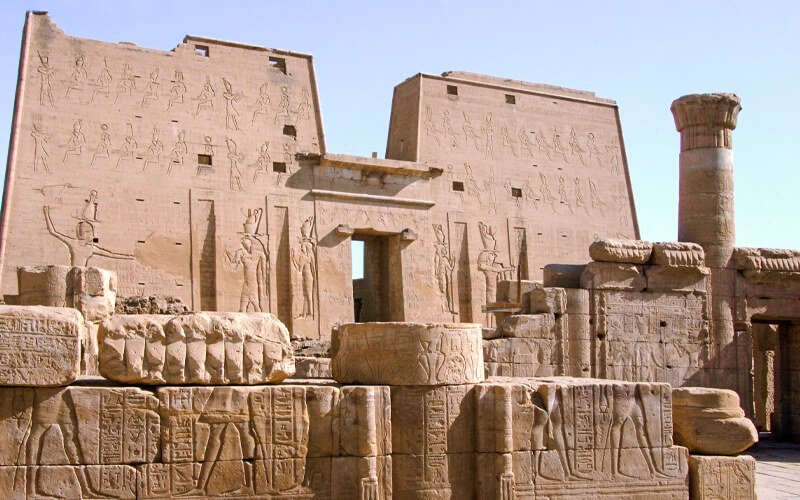
Upon entering, visitors are greeted by the grand pylon, decorated with reliefs showing Horus avenging his father Osiris by defeating Seth. This magnificent entrance sets the tone for what lies within—the sacred heart of one of Egypt’s greatest temples.
The Temple of Horus in Edfu contains several sections:
-
The Courtyard of Offerings, where worshippers presented gifts to Horus.
-
The Hypostyle Hall, supported by 12 massive columns representing unity and strength.
-
The Inner Sanctuary, housing the sacred statue of Horus.
-
The Naos, or holy shrine, made from black granite, symbolizing eternal protection.
What makes the Temple of Edfu Egypt so special is its detailed hieroglyphics. The walls are covered with more than 2,000 inscriptions depicting rituals, offerings, and celestial events. These carvings are not just artistic masterpieces—they’re a window into how ancient Egyptians viewed the universe.
Inside the Temple of Horus, travelers can see scenes of processions, ceremonies, and offerings that bring the temple to life. Many of these carvings show the Pharaoh in communion with Horus, reinforcing the divine connection between gods and rulers.
Architecturally, the Edfu Temple plan follows perfect symmetry, aligning with the sun’s path—a design intended to harness cosmic energy. When sunlight enters the main hall, it illuminates Horus’s sanctuary, creating a mystical glow that symbolizes divine presence.
For those passionate about ancient design, the Temple of Horus architecture is a marvel of geometry, proportion, and symbolism. It reflects the Egyptian belief that temples were microcosms of the universe—a place where heaven and earth met in harmony.
Religious Significance and Myths of Horus in Edfu
The Temple of Horus Edfu is more than just a monument—it’s a sacred space built to celebrate one of Egypt’s greatest myths. Horus, the falcon-headed god, was believed to be the son of Osiris and Isis. His eternal battle with his uncle Seth symbolized the struggle between order and chaos.
In Edfu Egypt, Horus was worshipped as Horus of Edfu, the avenger of his father. The temple served as a stage for religious dramas reenacting his victory over Seth. These ceremonies, recorded on the walls, include detailed descriptions of how priests played out the myth to ensure that cosmic order was renewed each year.
Travelers visiting the Horus Temple in Edfu can see reliefs showing Horus spearing Seth, who is depicted as a hippopotamus—a symbol of evil. This mythological story is not only a tale of divine revenge but also a metaphor for moral justice and the triumph of truth.
The Temple of Horus Egypt also had strong ties to the royal family. Pharaohs identified themselves with Horus, viewing the god as their divine protector. In ancient Egypt, to be “the son of Horus” meant to rule justly and maintain Ma’at, the principle of universal balance.
Many inscriptions within the Temple of Edfu reveal prayers asking Horus to grant victory, wisdom, and peace. The temple’s festivals drew pilgrims from all over Egypt, turning Edfu into a center of religious and cultural life.
Even today, visitors can feel this sacred energy when walking through the temple halls. The Edfu Horus Temple remains a symbol of spiritual power and the resilience of faith across centuries.
Daily Life and Ceremonies Inside the Temple of Horus
Life inside the Temple of Horus at Edfu was vibrant and deeply spiritual. The temple functioned as both a religious and economic center. Priests, workers, scribes, and artisans worked daily to keep the sacred rituals alive.
At dawn, priests performed purification ceremonies, bathing and dressing the statue of Horus of Edfu. They offered incense, bread, flowers, and wine, accompanied by chanting and the sound of sacred instruments. These rituals were believed to sustain the gods and keep the universe in harmony.
The temple also played a major role during the annual festival of Horus and Hathor, his divine consort from the Dendera Temple. During this grand celebration, the statue of Hathor traveled by boat along the Nile to Edfu. The reunion of the two deities was marked by music, dance, and offerings—a symbol of love, fertility, and cosmic balance.
In addition to its religious functions, the temple was an administrative hub. Records found in Edfu inscriptions show that it controlled vast lands and employed hundreds of people. Offerings collected from devotees supported both temple maintenance and local communities.
Walking inside the Temple of Horus, visitors can still see chambers that stored sacred objects, oils, and scrolls. The hieroglyphics decorating the walls narrate not just divine myths but also details about daily rituals, priestly duties, and the temple’s sacred calendar.
Every corner of the Edfu Temple Egypt tells a story—from the scent of incense that once filled the halls to the echo of prayers that once resonated through the hypostyle hall. When travelers visit today, they step into a living museum of devotion and cultural brilliance.
Rediscovery, Excavation, and Preservation of Edfu Temple
For centuries, the Temple of Edfu lay buried beneath layers of sand and debris. Locals built houses over the site, unaware of the magnificent structure below. It wasn’t until 1860, when French Egyptologist Auguste Mariette began excavations, that the temple was rediscovered in near-perfect condition.
The preservation of the Temple of Horus Edfu Egypt is extraordinary. Unlike other temples heavily damaged by time, earthquakes, or floods, Edfu remained largely intact. Its walls, statues, and inscriptions survived almost untouched, offering an authentic glimpse into the world of the ancient Egyptians.
Archaeologists found the Edfu Temple plan meticulously preserved, allowing them to study Ptolemaic religious architecture in detail. The Temple of Edfu hieroglyphics proved invaluable for understanding Egyptian mythology, language, and astronomy.
Today, preservation efforts continue under Egypt’s Ministry of Tourism and Antiquities. Modern lighting systems and pathways make it easier for travelers to explore the site while protecting its delicate carvings.
For photography enthusiasts, Temple of Edfu photos capture the golden hues of the sandstone and the intricate carvings that decorate every surface. Many visitors say the temple feels “alive,” as though Horus himself still watches over it.
Thanks to careful conservation, the Temple of Horus at Edfu remains one of the best-preserved temples in Egypt—second only to the Karnak Temple in scale and grandeur.
How to Visit the Temple of Edfu Today (Practical Travel Guide)
Visiting the Temple of Edfu Egypt is one of the highlights of any Nile cruise. Located on the west bank of the Nile between Luxor and Aswan, it’s a must-see stop for travelers exploring southern Egypt.
Most visitors reach Edfu by Nile cruise ship, which docks nearby, or by private tour arranged through Luxury Trips To Egypt, the leading travel agency in the country. Their expert guides provide deep insights into the temple’s history, architecture, and myths, ensuring travelers get the most out of their experience.
Edfu Temple location: The site lies about 105 km south of Luxor and 125 km north of Aswan, making it a perfect midpoint for travelers.
When planning your trip, the best time to visit is from October to April, when the weather is mild and the lighting is ideal for photography.
Edfu hotels and accommodations are available for travelers who wish to stay overnight, but most prefer to include the visit as part of their Nile cruise itinerary.
Inside the temple, it’s recommended to explore:
-
The Great Pylon, one of the tallest in Egypt.
-
The Inner Sanctuary, with the original shrine of Horus.
-
The Nilometer, used to measure the river’s flood levels.
-
The Chambers of Offerings, with scenes depicting the Pharaoh’s devotion.
Visitors interested in detailed Temple of Edfu facts or Temple of Horus facts can benefit from multilingual guides provided by Luxury Trips To Egypt, ensuring a rich and memorable exploration.
Luxury Trips To Egypt – The Best Way to Explore Edfu Temple
When it comes to exploring Egypt’s treasures, Luxury Trips To Egypt stands out as the premier travel agency. Specializing in tailor-made experiences, the agency combines comfort, expertise, and authenticity.
Their Edfu Temple tours offer travelers an in-depth understanding of both history and culture. With private guides, air-conditioned vehicles, and exclusive access to hidden corners of the Temple of Horus Edfu, every journey becomes truly personal.
Unlike standard tour packages, Luxury Trips To Egypt ensures travelers experience ancient wonders without the crowds. They also organize complete packages that include Aswan, Luxor, and Karnak Temple, creating a seamless travel experience through Egypt’s Nile Valley.
For those seeking luxury Nile cruises, the agency provides top-rated vessels with world-class amenities, gourmet dining, and guided excursions to major sites like the Temple of Horus at Edfu, Kom Ombo Temple, and Philae Temple.
By choosing Luxury Trips To Egypt, travelers not only visit historical monuments—they live the story of Egypt. Each tour is designed to create emotional connections and lasting memories while supporting local communities and preserving Egypt’s cultural heritage.
Fascinating Facts About the Temple of Edfu
-
The Temple of Edfu took 180 years to build, making it one of the longest temple constructions in Egyptian history.
-
The temple’s inscriptions form the largest collection of ancient temple texts in existence.
-
The Horus Temple Edfu aligns perfectly with the sun, reflecting the Egyptians’ astronomical precision.
-
The Edfu Temple map reveals secret chambers used for storing sacred relics.
-
The Temple of Horus, Edfu was buried under sand for nearly 2,000 years before its rediscovery.
-
The main entrance depicts Ptolemy XII striking down his enemies before Horus, symbolizing royal authority.
-
Edfu Temple inside features a complete ceiling decorated with images of the sky goddess Nut.
-
Edfu meaning in ancient Egyptian translates to “Behdet,” the seat of Horus’s power.
-
It is one of the most complete temples in Egypt, with roofs, walls, and pylons still intact.
-
The Temple of Edfu plan was used as a model for later temples, showing its lasting influence.
Conclusion: The Eternal Spirit of the Temple of Horus
The Temple of Edfu remains one of Egypt’s most majestic and inspiring sites. Standing tall along the Nile, it represents the enduring power of faith, art, and architecture. The Temple of Horus at Edfu captures the essence of ancient Egypt—its gods, myths, and people who sought to connect the earthly world with the divine.
For modern travelers, walking through its grand halls and studying its hieroglyphics is like stepping back in time. Every wall tells a story, every relief preserves a belief, and every shadow whispers the legacy of Horus of Edfu.
Exploring this magnificent site with Luxury Trips To Egypt transforms history into experience. Their passion for Egyptian heritage and dedication to exceptional service make them the ultimate partner for discovering the wonders of Egypt.
From Edfu Temple Egypt to the mighty Karnak, every journey reveals the timeless beauty of a civilization that still inspires the world today.