Pompey’s Pillar is one of Alexandria’s most famous landmarks and a true testament to the grandeur of ancient Egyptian and Roman civilizations. Standing tall over the ruins of the ancient city, this monumental column has fascinated travelers, historians, and archaeologists for centuries. When planning your visit to Alexandria, exploring Pompey’s Pillar should be at the top of your list — and there’s no better way to experience it than with Luxury Trips To Egypt, the best travel agency in Egypt specializing in guided cultural tours and historical adventures.
Pompey’s Pillar, also known as Pompeys Pillar or the Pillar of Pompey, rises majestically against the Alexandrian skyline. This Egypt pillar is not only the largest surviving Roman triumphal column outside of Rome but also one of the most iconic pillars in Egypt, symbolizing strength, endurance, and the legacy of the Greco-Roman era. Located on a rocky hill in the heart of Alexandria, the monument has become a defining feature of the city’s historical identity.
Travelers from around the world come to marvel at the Alexandria Pompey’s Pillar, which offers breathtaking views and deep insight into the city’s past. The monument has inspired countless studies, photographs, and documentaries about Egypt pillars and ancient architecture. Whether you’re a historian seeking knowledge, a photographer looking for the perfect shot, or a traveler curious about Egypt’s Roman history, visiting Pompey’s Pillar is an essential experience.
Nearby, you’ll also find the ancient Roman Theatre of Kom El Dekka in Alexandria, often searched as “this is the ancient roman theatre of Kom El Dekka in Alexandria in which country” — the answer, of course, is Egypt. Together, these landmarks paint a vivid picture of Alexandria’s glorious past as a hub of culture and learning.
The Fascinating History of Pompey’s Pillar
The Pompeys Pillar history is a captivating journey through time. Despite its popular name, the column has no direct connection to the Roman general Pompey the Great. The monument was actually erected in honor of Emperor Diocletian around 297 AD, commemorating his victory over a local rebellion and his generous act of feeding the people of Alexandria during a famine.
The name “Pompey’s Pillar” is believed to have originated from a misunderstanding during the Crusades, when European travelers assumed that the column marked the burial site of Pompey. The truth, however, is that the pillar in Egypt was constructed several centuries after Pompey’s death.
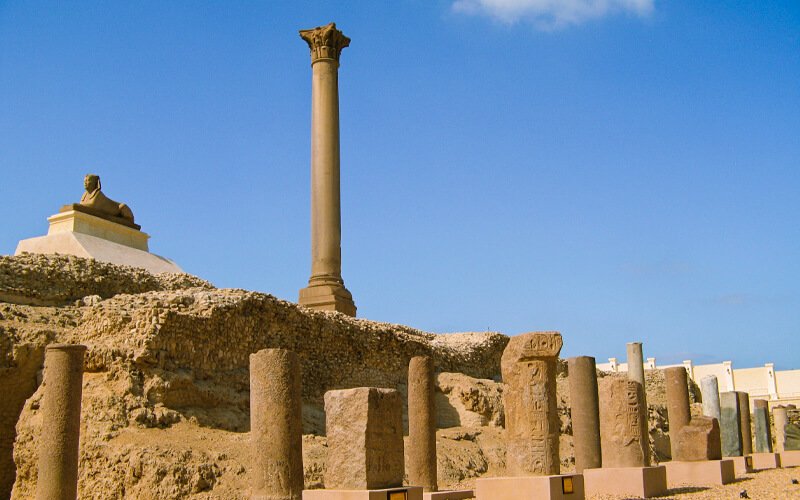
Carved from a single piece of red granite from Aswan, the Pompeii pillar stands approximately 26 meters (85 feet) high with a diameter of 2.7 meters. Its size and elegance make it one of the largest pillars in the world, and one of the most famous pillars in history. The capital, designed in the Corinthian style, displays the architectural genius of ancient craftsmen.
For centuries, the Pompey’s Pillar Alexandria has endured natural disasters, invasions, and urban development — yet it still stands proudly today. This durability represents the enduring strength of Alexandria Egypt history and the Roman legacy that continues to attract millions of travelers each year.
When visiting the site, travelers can explore the ruins of the Serapeum Temple that once surrounded the pillar — a temple dedicated to the Greco-Egyptian god Serapis. The area also contains fascinating underground galleries, remnants of ancient statues, and artifacts that tell stories of Pompey in Egypt, the history of Alexandria, and the evolution of religion and culture in the ancient world.
Architectural Brilliance – How Pompey’s Pillar Was Built
One of the most striking aspects of Pompey’s Pillar Alexandria Egypt is its remarkable engineering. Constructed using a single block of Aswan granite, the Egypt pillar weighs over 280 tons. Considering the limited technology of the Roman era, the transportation and erection of such a massive column were extraordinary achievements.
Historians believe the monument was originally part of a larger complex known as the Serapeum of Alexandria, one of the city’s most significant religious sites. The Pompeii column may have supported a statue of Emperor Diocletian or served as a monumental symbol of imperial power.
The craftsmanship is evident in the smooth polish of the stone and the precision of its Corinthian capital, decorated with acanthus leaves — a symbol often associated with strength and victory. Comparisons are often made between this monument and other pillars in Egypt, such as those in Karnak or Luxor, yet Pompey’s Pillar remains unique for being the only freestanding Roman triumphal column in the country.
While many travelers associate Egypt with pyramids, sphinxes, and temples, this pillar monument stands as proof that Egypt’s architectural legacy extends far beyond its Pharaonic past. It bridges the world of the ancient pharaohs with the might of Rome, illustrating the history of pillars as both religious and political symbols.
Visitors are often amazed by how such an ancient structure has survived time, earthquakes, and changing civilizations. Today, Pompeys Pillar Egypt remains an enduring example of the human spirit’s drive to build monuments that defy the limits of technology and time.
Pompey’s Pillar and the Ancient City of Alexandria
Alexandria was once one of the most magnificent cities of the ancient world — a city of knowledge, trade, and architectural innovation. Within this context, Pompey’s Pillar was more than a monument; it was a statement of power and prestige.
The pillar is located in what was once the acropolis of Alexandria, a high ground that held temples, statues, and royal buildings. The site is close to Kom El Dekka, home to the ancient Roman Theatre of Alexandria, further emphasizing the city’s importance as a cultural and intellectual center.
When travelers ask, “this is the ancient Roman Theatre of Kom El Dekka in Alexandria in which country?” — the answer connects directly to Egypt’s Roman heritage. Both the theatre and Pompey’s Pillar reflect Alexandria’s blend of Egyptian, Greek, and Roman influences.
Around the Pompey pillar in Alexandria Egypt, visitors can explore ruins of ancient streets, columns, and catacombs that once formed part of a thriving metropolis. These ruins, often described as Alexandria Egypt ruins, tell stories of philosophers, traders, and rulers who shaped the ancient world.
A guided tour with Luxury Trips To Egypt allows travelers to immerse themselves in this rich history, walk through time, and capture Pompey’s Pillar photos that reflect the beauty and mystery of the site. The agency’s professional Egyptologists make sure every detail of Alexandria’s past — from Pharos pillar to Pompey’s Pillar — is brought vividly to life.
Legends, Myths, and Symbolism Around Pompey’s Pillar
Throughout history, myths have surrounded Pompey’s Pillar. One popular legend claims that the column was built to honor the Roman general Pompey after his death in Egypt — a belief that gave rise to its name. However, archaeological evidence shows that the Pompeys Pillar monument was built several centuries later during Emperor Diocletian’s reign.
Some ancient travelers believed that the pillar of Pompey marked the general’s burial site. Others thought it symbolized the friendship between Egypt and Rome. Over time, these myths turned the site into a symbol of mystery and reverence.
Local folklore even connects the monument with Ptolemy Pompey, Pompey statue legends, and tales of hidden treasures buried beneath its base. Some researchers have explored the idea of pillars under pyramids, speculating that similar engineering techniques might have been used for Giza pyramid pillars or pillars under Egypt pyramids — an idea that continues to spark curiosity.
In the modern world, Pompey’s Pillar Alexandria history remains one of the most studied topics in classical archaeology. Historians continue to debate its exact purpose, while travelers continue to be inspired by its sheer majesty.
When you stand before the Pompeii’s Pillar, surrounded by the winds of Alexandria and the echoes of history, you can’t help but feel connected to the past — a sensation that Luxury Trips To Egypt ensures every traveler experiences fully.
Exploring Pompey’s Pillar Today – A Visitor’s Experience
Visiting Pompey’s Pillar today is a journey through time. Located southwest of Alexandria’s city center, the site is easily accessible and open to visitors daily. For those asking about Pompeys Pillar hours, it generally opens in the morning until late afternoon, with best visits occurring during early morning or sunset for photography.
Travelers are welcomed by the sight of the towering column surrounded by ancient ruins, open courtyards, and remnants of the Serapeum Temple. You’ll also encounter stone sphinxes and fragments that once adorned the temple complex.
Walking around the Pompeys Pillar Egypt site gives you a deep sense of wonder. The peaceful atmosphere, combined with the warm Egyptian sun, creates a magical experience. Visitors often spend time taking Pompey’s Pillar photos, learning about its history of Alexandria, and admiring how this monument has stood the test of time.
With Luxury Trips To Egypt, travelers enjoy expert-guided tours that provide exclusive insights into the site’s secrets, from ancient construction techniques to mythological stories. The agency’s local guides share fascinating details about Pompey’s Pillar Alexandria Egypt, ensuring a complete, enriching, and comfortable visit.
Nearby attractions include the Catacombs of Kom El Shokafa, the Roman Amphitheater of Alexandria, and the Alexandria National Museum, making this area a treasure trove for history lovers.
The Legacy of Pompey’s Pillar in Modern Times
Today, Pompey’s Pillar is not just an archaeological site; it’s a global symbol of Egypt’s historical depth. Featured in travel guides, documentaries, and even literature, the monument continues to inspire curiosity and admiration.
As one of the pillars of Egypt that bridges the ancient and Roman worlds, it stands alongside icons like the Pyramids of Giza and the Pharos Lighthouse in representing Egypt’s enduring legacy.
Archaeologists continue to study the area for evidence of hidden chambers or pillars under pyramids Egypt, linking ancient Egyptian and Greco-Roman engineering practices.
Pompey’s Pillar has become a key attraction in Egypt’s cultural tourism, drawing thousands of visitors every year. Its preservation is overseen by Egypt’s Ministry of Antiquities, ensuring that future generations can continue to witness this pillar place of history.
Luxury Trips To Egypt includes Pompey’s Pillar in its premium Alexandria tour packages, combining expert guidance with comfort, photography assistance, and authentic cultural experiences.
Travel Tips: Visiting Pompey’s Pillar with Luxury Trips To Egypt
For travelers planning to explore Pompey’s Pillar Alexandria, here are key tips:
-
Best Time to Visit: Early morning or late afternoon to avoid crowds and capture beautiful lighting for photos.
-
Entrance Fees: Usually affordable, with discounts for students and children.
-
What to Bring: Comfortable shoes, sun protection, and a camera for stunning Pompeii’s Pillar shots.
-
How to Visit: Booking with Luxury Trips To Egypt, the best travel agency in Egypt, ensures a hassle-free, informative, and enjoyable trip.
With Luxury Trips To Egypt, visitors can also explore Pompey’s Pillar national monument, Pompeii Egypt, and nearby Roman sites. Each tour is curated to offer not just sightseeing but a storytelling journey through Alexandria’s layered past.
Comparing Pompey’s Pillar to Other Ancient Pillars
When discussing the famous pillars of the world, few can rival Pompey’s Pillar in historical importance. While some might think of the Pillars of Giza, Pharos Pillar, or the Pillars under Egypt pyramids, none combine Roman elegance and Egyptian heritage quite like this monument.
It’s often compared with columns such as Trajan’s Column in Rome or the Corinthian columns of Greece. However, the Pompey pillar Egypt stands apart as a symbol of cultural unity — representing the meeting of civilizations that defined Alexandria’s identity.
As the oldest pillar in the world still standing in its original form within Egypt, Pompey’s Pillar embodies the brilliance of ancient craftsmanship. It remains one of the top sites to explore for anyone fascinated by Alexandria Egypt history or the history of Pompey himself.
Pompey’s Pillar – A Timeless Symbol of Egypt’s Grandeur
Standing in front of Pompey’s Pillar, you are reminded of the greatness of Alexandria’s past — a city once home to the legendary Library of Alexandria and the Pharos Lighthouse. This towering monument continues to tell the story of an empire that merged art, architecture, and power.
Whether you’re exploring the Alexandria ruins, admiring the Egypt pillars latest discoveries, or simply soaking in the atmosphere, Pompey’s Pillar Alexandria Egypt is a place that evokes awe and admiration.
For those wishing to experience it at its best, Luxury Trips To Egypt offers exclusive guided tours with historical insights, photography opportunities, and cultural context that make every visit meaningful and memorable.
Pompey’s Pillar is more than just a monument — it’s a bridge to the past, a symbol of endurance, and one of the great wonders that continue to define Egypt’s timeless charm.